For the 2 a.m. crowd
Why the Acid Still Finds You at 2 a.m., Even After Years on the Pill
The pill you take at breakfast turns the acid down. It never touches the valve at the top of your stomach. A loose door does not need less rain. It needs to close.
Reflux runs on two clocks. Covering both takes three jobs.
This is not about stopping anything. It is about the job a once-a-day pill was never built to do.
You did everything they told you to do.
You stopped eating by 7:30. You sleep on your left side. The wedge pillow has been under your mattress for years. And every single morning, without fail, you take the pill.
And still, a little after 2 a.m., you wake up with acid in your throat. The strange part is why — and it is not what you would guess.
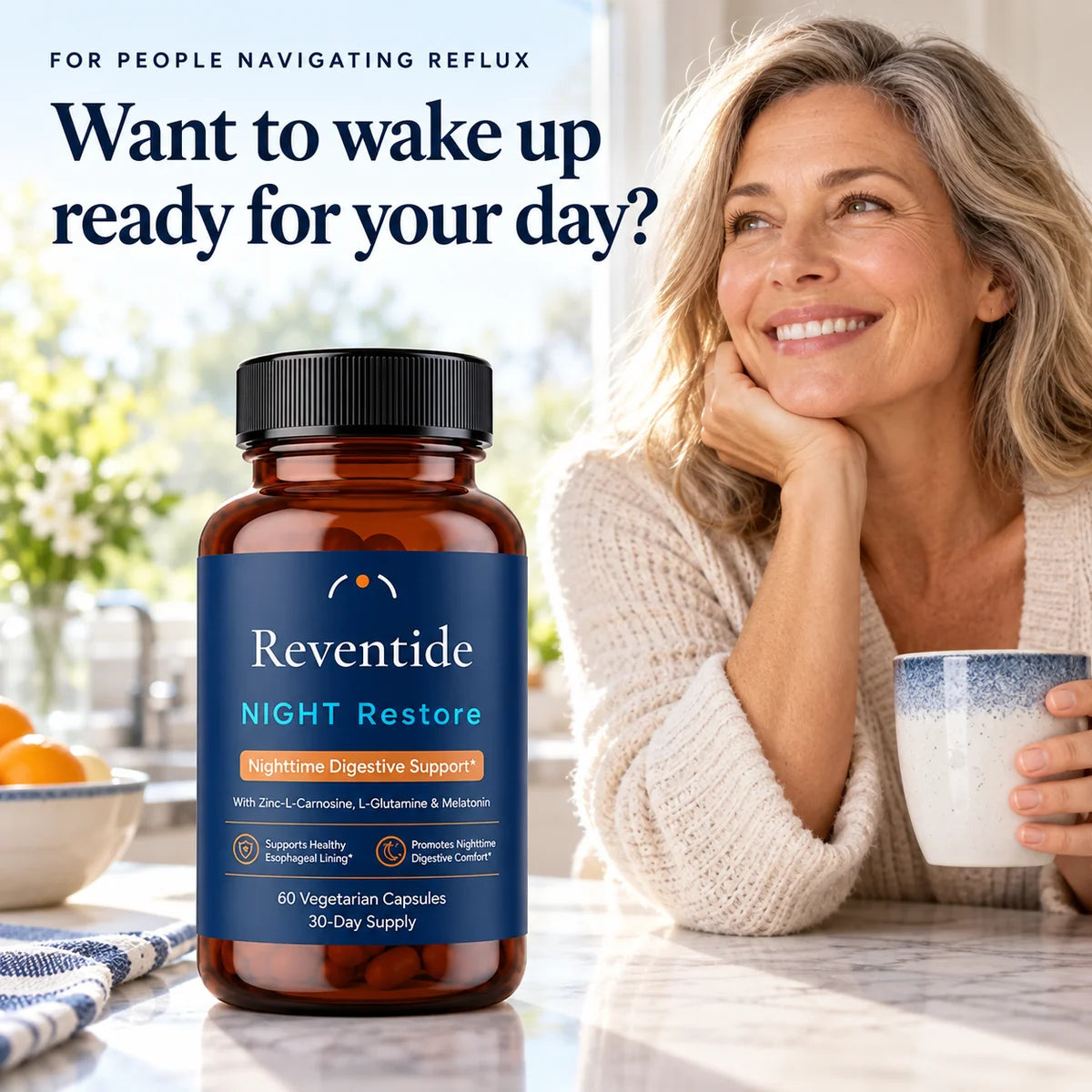
Some nights you sit straight up out of a dead sleep, coughing, and for a second the breath will not come. One hand is already reaching for the antacid roll on the nightstand, the one you keep where you can find it in the dark. By morning your voice is rough and your throat feels raw. And you are so tired of this being your normal.
But the nights are only where you notice it. The cost shows up in the mornings you move through half awake, and in the dinners you cut short before anyone else has finished.
A quiet thought has started to settle in. Maybe this is just what your body is now. You have carried it long enough to half believe it.
And it is not only acid that comes up. A digestive enzyme called pepsin rides up with it, which is why the throat stays rough on a morning that felt otherwise fine.
Here is the part almost no one explains to you. It is not that your body is broken, and it is not that you are doing something wrong. It is that the pill was built for a different clock than the one that keeps waking you.
And a loose door does not need less rain outside, it needs to close. Lowering the acid works on the rain.
What you were never told
Your stomach keeps its own clock
Acid is not the only thing that changes overnight. What changes is everything that was helping you during the day. Upright, gravity keeps stomach contents where they belong. Lying flat, it does not. You are not swallowing, so nothing gets cleared. For six or eight hours the tone of that valve is the only thing between your stomach and your throat.
Illustrative schematic only. Not a chart of measured data and not taken from any single study.
So the burning finds you in the dark, roughly on schedule, even on the days that feel manageable. And a once-a-day acid pill you swallow at breakfast is at its weakest exactly when that nighttime window begins. That is the drug’s rhythm running against your body’s.
It was the timing, not you
It was never your body failing
If you have tried to come off the pill before and it all came back, that was not weakness, and it was not a broken body. In a 2009 randomized, double-blind trial published in Gastroenterology, 120 healthy volunteers with no history of reflux took a proton pump inhibitor for eight weeks. After they stopped, 44% reported clinically relevant acid-related symptoms — heartburn, acid regurgitation or dyspepsia — compared with 15% on placebo.
Read that carefully, because it is a fact about a drug, not an instruction. It is not a reason to stop taking yours. Any change to a prescription belongs with your doctor. It is simply why this is built to sit alongside what your doctor has you on, never to replace it.
And the natural things you may have already tried — the licorice extract, the apple cider vinegar, the slippery elm — they were not useless. But each one only did a single job. And on its own, one job was never going to be enough, because the reflux that wakes you at night is really three problems stacked on top of each other.
The part the pill misses
Three jobs a once-a-day pill was never built to do
- 1It does not tighten the valve.There is a ring of muscle at the top of your stomach, the lower esophageal valve. It is supposed to stay shut while you sleep. When it sits loose, whatever is in your stomach can travel up while you lie flat. An acid pill does not touch that valve.
- 2It does not catch the pepsin.It is not only acid that comes up. A digestive enzyme called pepsin rides up with it and irritates the soft tissue of your throat. That is why you can still wake up hoarse and coughing even when the acid itself feels handled. A pill that only lowers acid does nothing about the pepsin.
- 3It does not settle the raw lining.After months of this, the lining of your esophagus stays worn and tender. Lowering acid does not do the quiet work of supporting that tissue back toward its natural strength.
Side by side
What a pill does, and what the two windows need
- Lowers how much acid your stomach makes
- Works from the inside, on a daily curve
- Does not sit on top of a meal
- Does nothing about the valve in the flat hours
- Window one, upright: something that caps the meal
- Window two, flat: support for the valve through the flat hours
- And the lining, overnight, over weeks
- Both windows, not one
30-day money-back guarantee · free U.S. shipping · no subscription
The 3-layer reflux reset
So a real approach has to cover all three — day and night
One thing for a loose valve. One thing for the pepsin. One thing for the worn lining. Miss any of the three and the nights stay bad. And here is the catch most formulas miss: the pool that rises at 2 a.m. is built earlier, at your largest meal, then finished off overnight while you lie flat. So a real approach has to run on two clocks — one move by day, one by night. The second clock runs through the flat hours.
That is the thinking behind a newer approach from a small supplement brand, Reventide. Rather than push acid lower, it was built around those three gaps, one layer for each, timed to the two windows that actually matter. Window one is mechanical: a full stomach, upright, pressing on the valve. Window two is flat: no gravity, no swallowing, for hours. They call it the 3-Layer Reflux Reset.
A raft on your biggest meal
Sodium alginate, pulled from seaweed, is a powder you stir into water and drink after your largest meal. In your stomach it forms a light gel raft that floats on top of what you just ate — a lid over the pool of acid and pepsin, set hours before you ever lie down. It is not absorbed into your body. A 2017 meta-analysis of 14 randomized trials (2,095 patients, Diseases of the Esophagus) found alginate-based therapies were significantly more likely to resolve reflux symptoms than placebo or antacids (odds ratio 4.42). Day Shield uses the same alginate salt — sodium alginate — at 1,000 mg per stick. Those trials dosed several times a day; we make no claim to match their dosing. Research on the ingredient class, not on the finished product.
Sodium Alginate · 1,000 mg · day drink
Not the sleep kind of melatonin
Here is the part that surprises people. “I already take melatonin to sleep. How is this any different?” It is different because this is not really about sleep. Researchers report the gut contains at least 400× more melatonin than the pineal gland — the gland in the brain that releases it at night (a review in Digestive Diseases and Sciences, 2002). Melatonin has been studied for its effect on lower esophageal sphincter tone — in one small clinical study, at 3 mg taken at bedtime. Night Restore provides 2.7 mg. Research on the ingredient, not on the finished product.
Night Restore contains melatonin, which may cause drowsiness — do not drive or operate heavy machinery after taking it.
Melatonin · 2.7 mg · night capsulesThe layer that works on the raw part
After months of this, the lining stays worn and tender. In a randomized, placebo-controlled trial, a zinc-carnosine complex helped support intestinal lining integrity in healthy adults exposed to a common gut irritant. Night Restore provides 135 mg of zinc carnosine per serving, paired with L-glutamine. Research on the ingredient, not on the finished product. DGL, a lighter licorice extract, rides along in the day drink at 500 mg — listed on the label at its full dose, with no study claim attached to it.
Zinc-L-Carnosine 135 mg + L-Glutamine 900 mg (night) · DGL 500 mg (day)30-day money-back guarantee · Free shipping
Two formulas, one system
A drink by day. Two capsules by night.
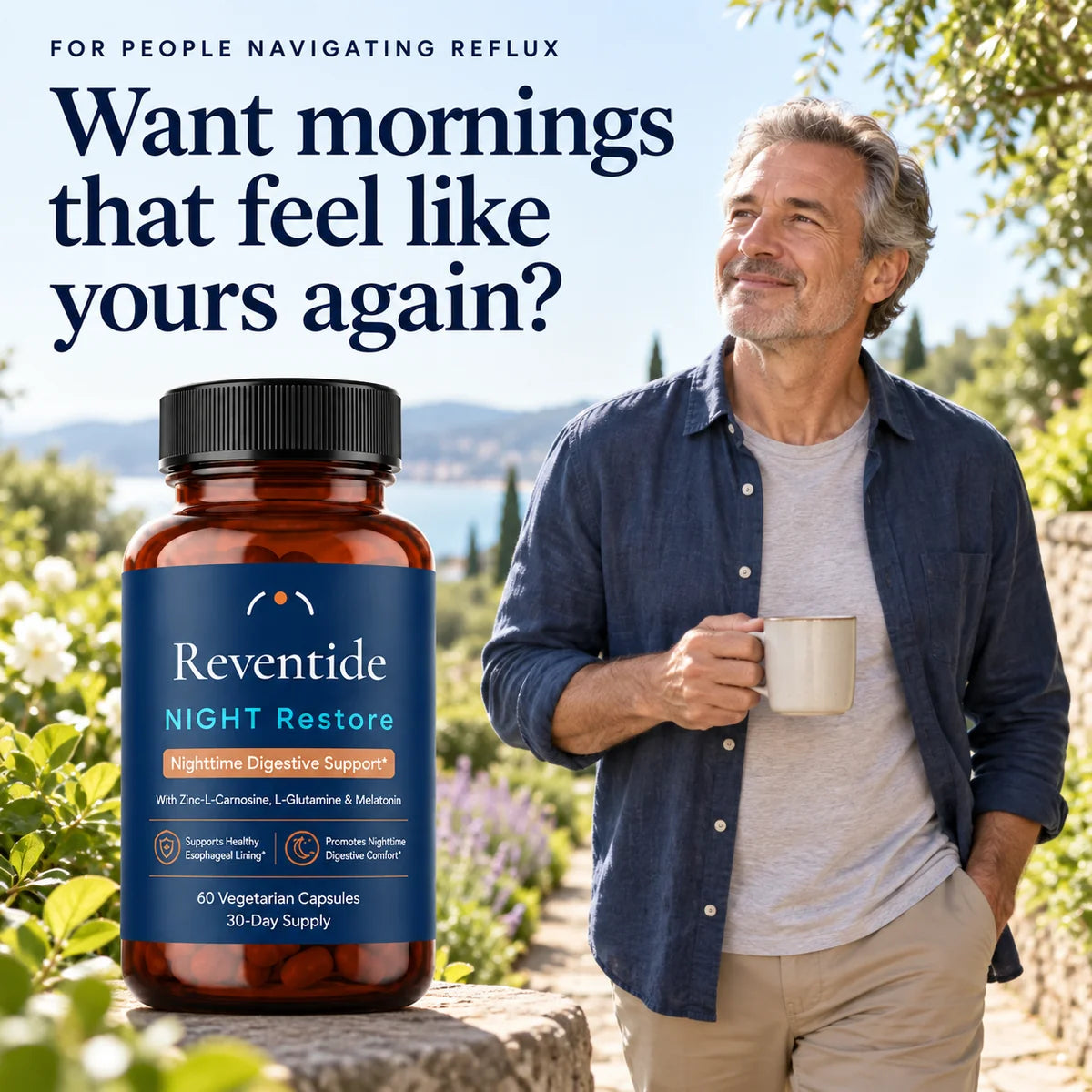
The day formula is a drink you stir into water after your biggest meal. That is when the raft forms, capping the pool before it can rise, and it carries the daytime lining ingredient. There is no melatonin in it, so nothing makes you foggy at your desk. The night formula is two capsules about 30 minutes before you lie down — the valve and lining support, landing right as the acid climbs. That is the whole routine. No wedge to prop up. No antacids to ration.
Nothing hidden
Every milligram is printed on the label
When a formula hides its doses inside a “proprietary blend,” it is usually because the doses are too small to matter. Some brands go halfway: they name the ingredient, then leave the actual milligrams to a photo of the label you have to squint at. Reventide prints every number in plain text. No blend. No squinting. Nothing to look up.
Made in a cGMP-certified, FDA-registered facility. Every milligram printed on the label, no proprietary blends.
Night Restore contains melatonin, which may cause drowsiness — do not drive or operate heavy machinery after taking it.
Day Shield carries 336 mg of sodium per stick — if you’re on a sodium-restricted diet or have high blood pressure, talk to your doctor.
30-day money-back guarantee · Free shipping · No subscription
In their own words
What people describe about the nights
We are not going to put words in anyone’s mouth. But these are the kinds of things people write, over and over, in public reflux forums about the 2 a.m. hours:
If any of those sound like your own week, the reason is not that you have not tried hard enough. It is that nothing you tried was built for all three jobs at the same time, across both windows.
What it costs
Less per day than the antacids you already buy
One kit is $69, about $2.30 a day. On the 90-day protocol it is $46 a kit, about $1.53 a day, because the third kit is free. Less than the coffee you brace yourself to drink each morning. And this part is worth sitting with: you are already paying. For the antacids gone by Thursday. For the wedge pillow that has been under the mattress for four years. For the half-used jars of things that each did one job and quit. All of that money manages the nights. It does not change them.
Before you decide
The questions people ask first
Will it make me drowsy during the day? +
Can I take it if I am already on an acid blocker? +
Is this just Gaviscon? +
How soon might I notice a difference? +
Is there anything I should check first? +
What if it does not work for me? +
The goal
One flat night, and then another
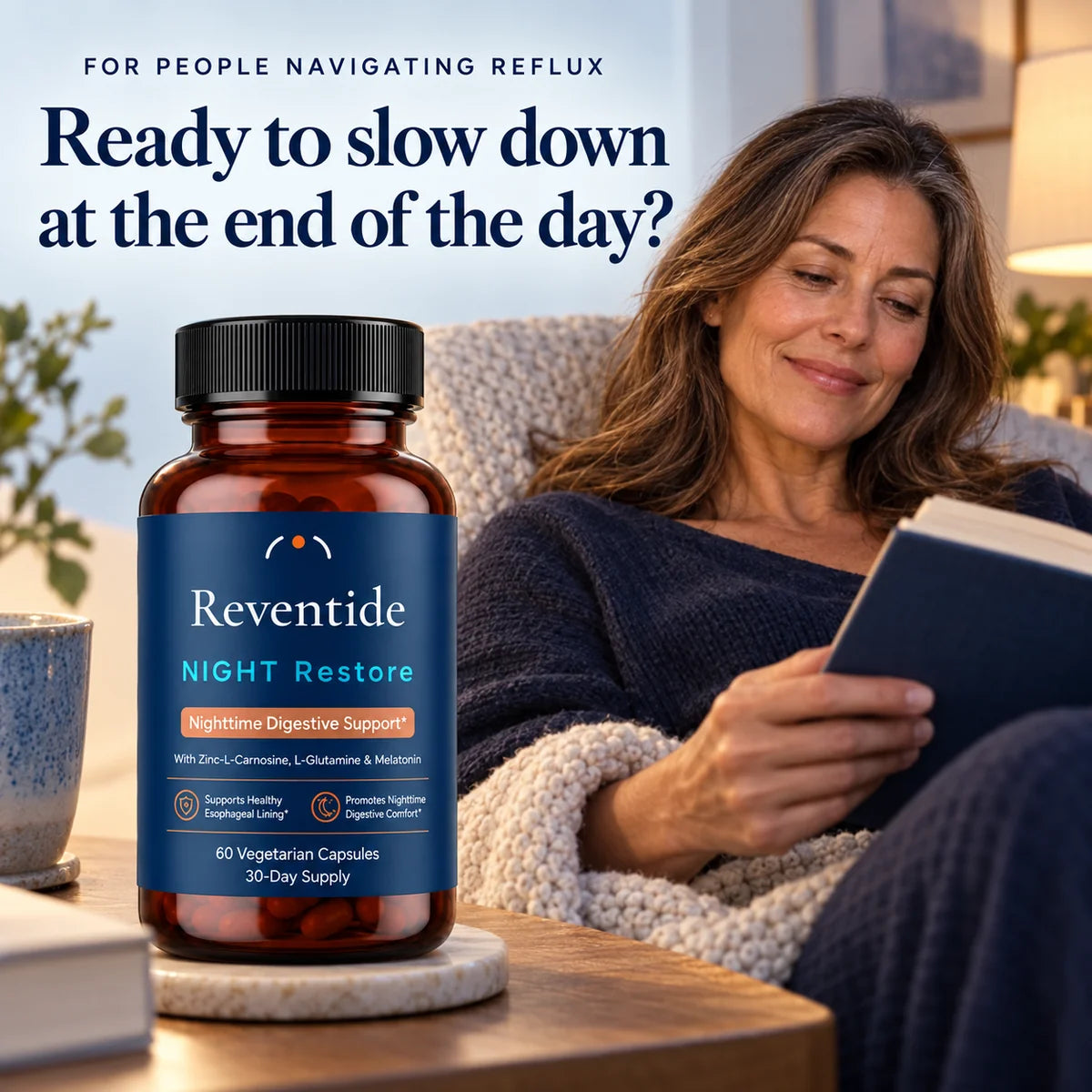
Picture the first morning you wake up flat on the pillow. No wedge propping you up. No 2 a.m. scramble in the dark. The antacid roll still sitting closed on the nightstand. You slept the whole way through, and you can feel it in how you stand up.
And it reaches past the night. Coffee in the morning without bracing for the burn. Dinner out without rationing what you order.
That is the whole point of the three layers. Not to add one more thing to your night. To finally give the night back to you.
Start the reset
Give the night back to yourself
Everything the 90-day protocol puts to work, across both windows:
- The barrier layer — the day drink caps your biggest meal, so less can rise while you lie flat.
- The valve-support layer — at night, supports the tone of the valve through the late-night window.
- The lining layer — works night and day.
Plus two guides, included free with every kit, at every size:
- The PPI Conversation Guide ($29) — the questions worth bringing to your next appointment, and what to track before you go.
- The Quiet Nights Playbook ($19) — a simple evening setup and a 2 a.m. routine you can put to work tonight.
Take the full 30 days. If you are not sleeping flatter, send the kits back, empty packaging included, for every cent back. Return shipping is on us. And it is a one-time purchase, not a subscription: no auto-charge, no cancellation hoops, no bottles you did not order turning up on your card.

Choose your protocol
How long you give it decides what you find out
This is a dietary supplement, not a drug.