The Evening Digest
Reflux · The Two Windows
Why your body stops protecting itself for seven hours every night
Two windows. One prescription. The half of reflux that omeprazole — or any other daily acid pill — was never designed to reach.
Reflux runs on two clocks. Omeprazole only winds one of them.
 Ellen Marsh, Contributing Editor
·
March 2026
A dentist squinting at the back of someone's front teeth and asking about soda. A stack of four pillows and a wedge that promised everything. A kitchen light switched on at two in the morning, for the third time this week.
Three complaints, three different people, three doctors' offices that would file them under three different headings. Underneath all of them, the same event, at the same hour, for the same reason.
It has very little to do with how much acid a stomach produces, and almost everything to do with what stops happening once you lie down.
Why this is worth five minutes
Almost everything sold for reflux covers one window. Almost everyone buys as if there were only one.
Reflux gets treated as a quantity problem: too much acid, so make less acid. That is what omeprazole does — it is a proton pump inhibitor, one of the drugs that turn down how much acid the stomach makes — and it holds up well enough between breakfast and dinner, which is why so many people call their days manageable and their nights a different animal entirely.
So the promise here is small. By the end of this you will be able to say in one sentence why the night version behaves differently from the day version — and you will have three requirements you can hold against any product on the shelf, including the one advertised at the bottom of this page.
The moment it clicks
The clearest description of this was posted at one in the morning, by someone who could not sleep
"Not sure what need my body has for stomach acid at 1am when I haven't consumed anything since 5pm. Boggles the mind."r/GERD
Underneath the sarcasm sits the sharpest question in the whole condition, and almost nobody answers it. Nothing eaten for eight hours. Nothing provoked. The body picks that hour anyway.
Picture the week it finally clicks. Maybe your version looks like this. Tuesday you are up at two, and because you are annoyed and awake anyway, you type the time into the notes app on your phone. Wednesday you do it again. By Sunday there are five lines in that note, and they are almost the same line: 2:14. 2:06. 1:58. 2:11. 2:03.
That is the first thing you notice — the clock, not the food. There was a salad on the Thursday and pizza on the Friday, and the hour barely moved.
The second thing takes longer to admit, because it sounds like good news and does not feel like it. Your days are basically fine. You eat lunch at your desk. You drink the coffee. Nothing happens. If someone asked you at four in the afternoon whether you had a reflux problem, you would have to stop and think about it.
Fine days. Ruined nights. Same stomach, same body, no change in how much acid. Something changes at bedtime that has nothing to do with how much of it there is.
The epiphany is not dramatic. It is noticing that daytime and nighttime episodes do not behave alike. Daytime burning arrives, peaks and fades in minutes. The night version wakes you out of sleep, and you can still taste it two hours later. Two behaviors, one name. Treat them with one tool and you end up somewhere very specific:
"This is the life of GERD isn't it. We fix one problem and that causes another. One day we'll have cycled through everything possible and be cured... maybe?"r/GERD
What you already tried
You did not do nothing. You did reasonable things — aimed at the wrong half.

-
01 · Omeprazole and the other acid blockers
It does exactly what it says, at one end of the day
Omeprazole reduces how much acid the stomach produces — a real effect, and for many people a necessary one. What it does not do is touch the hours when nothing is being swept back down. The same goes for the other proton pump inhibitors on the shelf: esomeprazole, lansoprazole, pantoprazole. And most people only find out about the second property of these drugs when they try to come off them.
On stopping the drug In a 2009 randomized, double-blind trial published in Gastroenterology, 120 healthy volunteers with no history of reflux took a proton pump inhibitor for eight weeks. After they stopped, 44% reported clinically relevant acid-related symptoms — heartburn, acid regurgitation or dyspepsia — compared with 15% on placebo.Healthy people. No reflux before the study. Symptoms after stopping. Researchers call it rebound acid hypersecretion — a documented property of the medication, not a verdict on your body.
"I too spent 10+ years figuring I needed this life long as every time I stopped I got awful reflux. No doctor has ever mentioned the rebound effect despite me going to them about the reflux occasionally over the years. I honestly didn't know it was a thing until now."r/GERD
Nobody here is telling you to change your prescription — that belongs to you and the doctor who wrote it. The point is narrower: what came back when you stopped was not proof that you are broken.
-
02 · Antacids and chewables
A minutes-long tool against a seven-hour window
They neutralize what is already there, fast, and then they are finished. Which is why the bedside roll keeps emptying.
Correct for a moment. Useless for a night.
-
03 · The angle and the rules
Pillows give back gravity. Nothing after seven shrinks the input.
The wedge, the blocks under the bed legs, the no-tomatoes list, the left side only — the most rational things on this page, and they half-work for that reason. The angle restores one of the two protections you lose lying down; the rules shrink what goes into the window. Neither changes what the window is, which is why people who follow all of it still get up at two.
Right instinct, half the mechanism.
-
04 · The supplement shelf
Each one a partial answer, delivered at the wrong moment
DGL is taken for the lining, and does nothing about stomach contents escaping mechanically after a meal. Apple cider vinegar answers a different theory altogether. Probiotics are not in the room when reflux happens. Melatonin you may well have taken already — as a sleep aid, paired with nothing, with nobody mentioning the muscle at the top of your stomach.
"Sadly i can't stop nexium for more than 3 days and acid reflux comes back, tried gaviscon tablets, betain hcl with pepsin from 1 to 14 capsules and didn't help."r/Supplements
None of it is a scam. Each was one form, at one time, for a problem that runs on two.
The part nobody explained
Awake, your body cleans up after itself all day long. Asleep, it stops.
It is happening right now, and you have never once caught yourself doing it: you swallow, again and again, all day, and every swallow sweeps acid back down where it belongs. You are upright, so gravity pulls the same way. Together that is a quiet cleanup service running non-stop — the reason a daytime flare fades in minutes even when things slip a little.
It has help doing that. Where the food pipe meets the stomach, there is a small ring of muscle — the valve, as the diagrams call it — and during the day, it rarely has to work alone.
The moment you fall asleep, the service goes offline. Swallowing nearly stops. You are horizontal, so gravity switches sides. For the next seven hours that small ring is doing the whole job alone — and anything that gets past it does not get swept anywhere. It sits. Against your throat, your voice box, the back of your teeth.
You do not have one reflux problem that gets worse at night. You have two problems that share a name.
That is why the hour is so consistent, and why a treatment aimed at how much acid you produce can work all day and still leave those seven hours exactly as they were. Different clock, different problem.
What a real fix would have to do
Three requirements — write them down before anyone shows you a product
- Right timing. Something has to be working after meals and through the night — not once in the morning, hours before either window opens.
- Something physical, where it starts. Not only a change to the chemistry of what is in the stomach, but a barrier at the place the trouble begins.
- No lifestyle tax. It cannot depend on sleeping upright, skipping dinner, or rearranging your life around the bed.
Hold those three against everything on the shelf, including what comes next.
The two-part routine
Reventide
Two formulas, because there are two windows. One after your largest meal, one before bed. Neither is a drug, and neither is trying to be one. Two clocks, three jobs — a barrier by day, a ring and a lining by night — covering the seven hours the label on your morning pill was never asked to reach.
DayShield — a temporary raft on top of what you just ate
One stick, stirred into water after your biggest meal. Sodium alginate reacts with stomach acid and forms a floating raft on top of the stomach contents — a physical barrier at the place where the trouble starts, in the hours before you lie down.
1 stick · 1,000 mg sodium alginate
NIGHT Restore — for the shift that ring is pulling alone
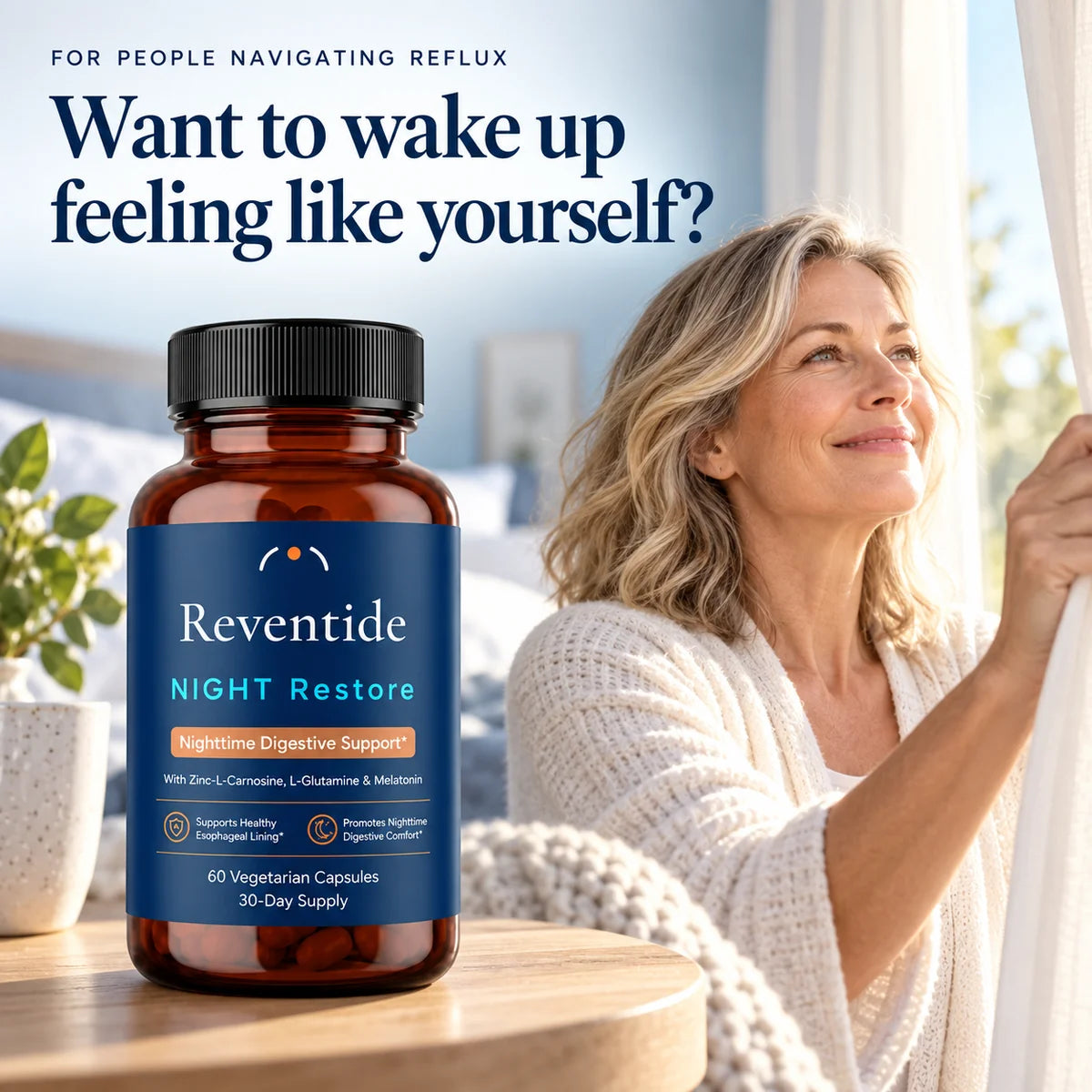
Two capsules about thirty minutes before bed. That ring of muscle at the top of the stomach has a clinical name: the lower esophageal sphincter. Melatonin has been studied for its effect on lower esophageal sphincter tone — in one small clinical study, at 3 mg taken at bedtime. NIGHT Restore provides 2.7 mg. Research on the ingredient, not on the finished product. Alongside it, zinc carnosine for the lining, plus L-glutamine and vitamin D3.
2 capsules · zinc carnosine 135 mg · L-glutamine 900 mg · melatonin 2.7 mg · vitamin D3 1,800 IUDay barrier. Night ring. Night lining.
30-day money-back guarantee · empty packaging accepted · free U.S. shipping · no subscription
Which window is yours
Where on this list do you actually recognize yourself?
- After dinnerBurning within an hour of the meal, gone by bedtime.
- Lying downFine until you are horizontal, then it starts within twenty minutes.
- Around 2 a.m.Woken by it, upright before you are properly awake, still tasting it later.
- In the morningSour film on the tongue, a voice that needs clearing, a dentist asking about soda.
The bottom two are the night window — the ones omeprazole never covered.
What is actually in it
Every milligram printed — including the numbers that do not flatter the label
Now the part most brands leave out — three places where the numbers on these panels do not line up with the research:
-
1The alginate trials dosed several times a day. DayShield is one stick.
Its 1,000 mg is a fraction of the daily amounts used there, and Reventide does not claim it matches what the research used.
-
2The melatonin study used 3 mg. NIGHT Restore uses 2.7 mg.
3 mg is not 2.7 mg, and one small study is not proof. Both numbers are printed above.
-
3DGL is in there with no study attached.
It is listed, it is dosed, and no claim is made for it. The daytime argument rests entirely on the alginate.
That is the only real reason to trust a label: not that it promises the most, but that it says where it is thin. Both formulas are made in a cGMP-certified, FDA-registered facility, with no proprietary blend on either panel. Both panels in full are on the product page.
The short version
Four sentences, and you have the whole argument
- The cause: at night you lose swallowing and gravity, and one small ring covers seven hours alone.
- Why nothing worked: everything you tried covered one window — omeprazole or whichever acid blocker you were handed, angle, rules, shelf.
- What is required: right timing, something physical where it starts, no sleeping upright forever.
- Why this one: two formulas for two windows, every milligram printed, the gaps in the evidence spelled out on the page instead of left for you to find.
What it costs you in effort
One stick stirred into water after your largest meal, two capsules half an hour before bed. That is the whole routine.
Before you decide
Do I have to come off my prescription to try this?+
Isn't this just Gaviscon?+
What people who tried it are saying
Four questions people had before buying — from people who bought
“What sold me was the label. Every dose printed, nothing hiding behind a ‘proprietary blend.’ I’ve thrown money at formulas that never told me how little was actually in them — this is the first one where I could check the math. Three months in and the mornings feel steadier.”
Greg T. — Texas · verified purchase
“I’ve done the wedge pillow, the no-food-after-7 rule, all of it. The nights were still rough even on my morning pill. About six weeks in and I’m staying asleep more nights than not. It’s not every single night, but it’s a different baseline than I’ve had in years.”
Karen M. — Florida · verified purchase
“I was nervous about adding anything to a stomach that was already unpredictable, so I eased into it. A few weeks in, the after-dinner heaviness isn’t the whole-evening event it used to be. Not a magic switch — but I’ve stopped dreading dinner. One star off because I’d prefer the drink a little less minty.”
Sandra P. — verified purchase
“The first couple of weeks I noticed I wasn’t reaching for the antacids at 2 a.m. anymore. I still keep a roll in the nightstand out of habit, but that drawer has stayed shut for a while now. I take the night capsules right before bed and mostly forget about them until morning.”
Diane R. — Ohio · verified purchase
Reproduced verbatim from Reventide’s own product page — full names, star counts, and the four-star review included as posted. Individual results vary.
30-day money-back guarantee · empty packaging accepted · free U.S. shipping · no subscription
Take the full thirty days and use it properly. If the nights have not changed, the kits go back for a full refund, empty packaging included. Reventide does not ask for unopened boxes, because a product you never opened proves nothing either way. Free U.S. shipping, no subscription.
The goal is almost embarrassingly small, and deliberately so: one night where the kitchen light stays off and the bedside roll goes untouched. Then another one. That is something you can check on a Tuesday morning.

Most people start with the three-kit bundle, because three months is the honest length of the test.
So the only question this article was ever going to end on: do you want to cover both windows, or keep covering one?
30-day money-back guarantee · empty packaging accepted · free U.S. shipping · no subscription
This is a dietary supplement, not a drug.
Reventide
These statements have not been evaluated by the Food and Drug Administration. This product is not intended to diagnose, treat, cure, or prevent any disease.
This is an advertisement. Reventide is the maker of the products described above, and this article was produced and paid for by Reventide — read every line with that in mind. Nothing here rests on the advertiser's word: every claim made about the research is tied to a named study in the list below, and where the research does not cover the finished formula, that is said in the same sentence. Quotations from public forums are reproduced verbatim, including original spelling, and are not customer testimonials for any product.
Sources
- Leiman DA, Riff BP, Morgan S, et al. Alginate therapy is effective treatment for gastroesophageal reflux disease symptoms. Diseases of the Esophagus. 2017;30(5):1–9. PubMed
- Reimer C, Søndergaard B, Hilsted L, Bytzer P. Proton-pump inhibitor therapy induces acid-related symptoms in healthy volunteers after withdrawal of therapy. Gastroenterology. 2009;137(1):80–87. PubMed
- Mahmood A, FitzGerald AJ, Marchbank T, et al. Zinc carnosine, a health food supplement that stabilises small bowel integrity. Gut. 2007;56(2):168–175. PubMed Central
- Kandil TS, Mousa AA, El-Gendy AA, Abbas AM. The potential therapeutic effect of melatonin in gastro-esophageal reflux disease. BMC Gastroenterology. 2010;10:7. Springer