Nighttime Reflux
There's a reason your reflux wakes you at 2 a.m. and not at 2 p.m. And it's not the food.
You've cut the late dinners, skipped the trigger foods, taken the pill every morning. And you still wake up at 2 a.m. Reflux runs on two clocks. Covering both takes three jobs. Almost everything you've tried was built for the clock that was never the problem. Lying flat is when the valve is on its own.
Reflux runs on two clocks. Covering both takes three jobs.
 By Nicole Eck 8 min read
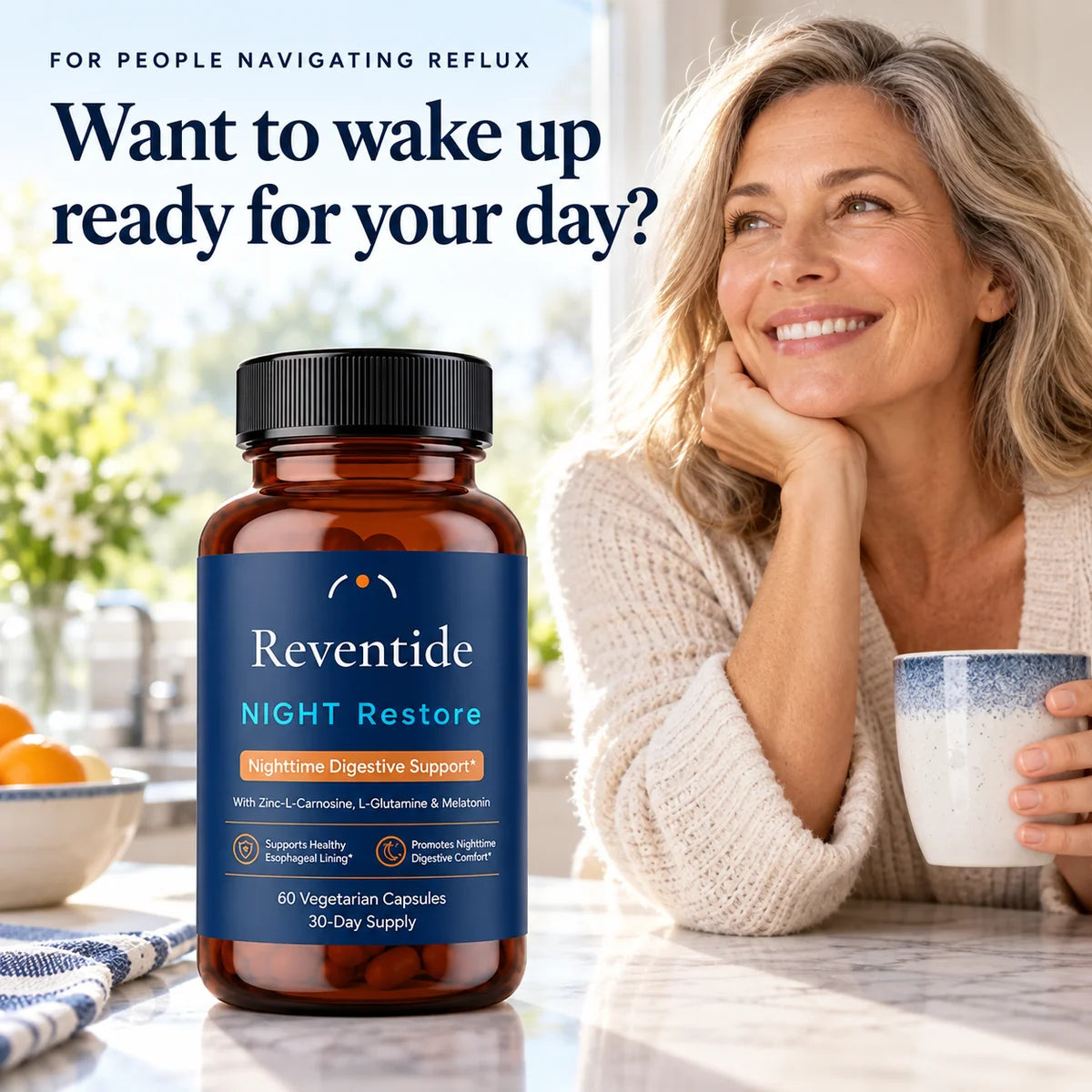
Diane R. from Columbus hadn't slept flat in years. Seven years of reflux, and the nights were always the worst part. So she did everything the internet and her doctor told her to. She bought the wedge pillow, and slid off it by 2 a.m. anyway. She stopped eating after seven, and still woke up burning. She moved to her left side because a forum swore by it, then lay awake wondering why it wasn't working. She took omeprazole every single morning, like clockwork, and the nights never got the message. Every fix helped a little, or for a while, or not at all. She'd spent real money chasing relief, and still braced for 2 a.m. like an appointment she couldn't cancel.
And still, most nights, a little after 2 a.m., she'd wake to that sour heat climbing her throat, half-sit up in the dark, careful not to wake her husband, and reach for the roll of Tums on the nightstand she already knew was half gone. Then lie back on her pile of pillows, never quite flat, and wait for morning.
By then there was more than one roll. One in the nightstand drawer, one in the car door, one in her bag next to the keys and the phone and the wallet, so she was never more than an arm's length from it. Nobody plans that. It's what you end up doing when the only thing that reliably helps is something that neutralizes what's already up there, after it's already up there.
Here's what took her seven years to realize: the food was never really the problem. She'd cut the late dinners, dropped the trigger foods, done all of it. Her days were mostly fine. It was only when she lay down that it hit. The thing setting off her nights wasn't on her plate. It was something that happens the moment you go flat, and it's the reason 2 a.m. is the worst hour of her day and 2 p.m. is not.
By her own admission, she'd stopped expecting anything to change. She'd been let down too many times. So when she started the thing she tried next, she went in flat-out skeptical. In her words: "I genuinely didn't expect this to do much."
What happened in the third week, she wasn't expecting at all. I'll come back to it, because it only makes sense once you understand the thing Diane didn't: for seven years, she'd been fighting reflux at one time of day. And reflux isn't a one-time-of-day problem. It runs on a 24-hour clock, and she'd only ever been fighting half of it.
Where on this list are you?
- After dinnerBurning an hour after the plate is cleared
- Lying downYou stopped sleeping flat on purpose
- Middle of the nightAwake at 2 a.m. with acid in your throat
- Every nightYou plan dinner around your stomach
- Still on the prescriptionThe mornings are fine. The nights are not.
Those two rows are one window.
That window is the second clock, and it's the one nothing you've tried was built for.
That's the part almost nobody explains. So let's.
The half your morning pill never touches
Why the nights are the worst
Think about Diane's day versus Diane's night.
All day she's upright, and gravity is quietly on her side, keeping stomach contents where they belong. That's why reflux is usually a background annoyance while you're vertical. Her omeprazole handled that stretch fine.

Then she lay down. Flat, or as flat as the pillows let her. Gravity switched off. From that moment one thing was holding her stomach shut, and only one: the ring of muscle at the top of it. All day that ring has gravity helping it. At 2 a.m. it works alone, for six or eight hours, while she is asleep and cannot do a thing about it. That's the 2 a.m. burn. It isn't random and it isn't in your head. It's physics. It's the same reason Marcus ended up sleeping propped on a mound of pillows for years, because lying flat meant waking up choking, the kind of thing that, in his words, "scared the hell out of me."
And here's the part that explains why it never fully went away for Diane, no matter what she tried:
Every time acid reached the lining of her esophagus, it irritated it. One night isn't the problem. The problem is the loop. Night after night, the same tissue gets hit and never gets a real stretch of calm to settle, so it stays sensitized. A quick antacid neutralizes acid for an hour but does nothing about the loop. Antacids reach what is already up there. They never reach the valve. Her morning PPI targeted the daytime. Neither was built for the eight flat hours when she was most exposed and least protected.
That's the second clock. One runs while you're upright and gravity is helping. The other runs the eight flat hours when it isn't. For seven years she treated the first clock and left the second one wide open. Every single night.
And the loop compounds. Tissue that never gets a real stretch of calm stays sensitized, which is why for so many people the window between "fine" and 2 a.m. quietly gets shorter every year. This isn't a problem that waits politely while you treat half of it.
That's the real reason "everything" hadn't worked for her. Not because her body was broken. Because the tools were only ever built for half the day.
The pillows were never the problem

Almost everyone here has built the same workaround. A second pillow, then a third, then a wedge, and eventually a setup you have to rebuild every night before you can even lie down. Diane bought the wedge. Marcus spent years on a mound of pillows.
Here's what propping yourself up actually does: it tilts you enough that gravity keeps doing a little of the work it does all day. That's the entire mechanism. Gravity was doing the valve's job. Which is also why it stops the moment you slide off the wedge at 2 a.m., and why an inch of tilt has never once done anything for the valve itself.
So the pillows were never the problem. They were never the fix either. They were a stand-in for the one thing that has to hold when you're flat, and they slip off the job every night at around the same hour.
"Six years, more doctors than I can count. Prescription meds did next to nothing for the nights. The 2am episodes have gotten rare enough that I actually sleep now. That alone is worth it to me."
Robert H. · Erie, PA · Verified Buyer
30-day money-back guarantee · free U.S. shipping · no subscription
What has to change before flat is comfortable
How to sleep flat again
Strip it down to the mechanics and there are only two clocks to cover, and the second one runs on different rules.
While you're upright, two things keep stomach contents where they belong: the valve at the top of the stomach, and gravity. Gravity carries a large share of that, quietly, all day, for free. It's why the daytime is manageable for most people here, pill or no pill.
Lie down and one of the two disappears. Gravity is out. Whatever the valve holds is now the entire margin. Nothing got worse at 2 a.m. You simply lost half of what was covering you, at the hour you're least able to do anything about it.
So sleeping flat isn't a question of willpower or the right angle. Three things have to be true. First, as little as possible should be sitting at the top of the stomach when you go horizontal, and that's decided hours earlier at your largest meal, not at bedtime. Second, the valve has to hold on its own, because it no longer has gravity backing it up. Third, the lining needs long stretches of calm, because tissue that gets hit night after night never gets the chance to settle.
Look at those three and you can see why the usual moves fall short. The wedge borrows gravity back for a few hours and does nothing for the other two. An antacid handles what is already up there and nothing about what happens at 3 a.m. The morning pill is set to the first clock. None of them are useless. They're each aimed at one line of a three-line problem, which is why people stack all three and still wake up.
So what actually covers the nights?
That's the whole of it. Reflux runs on two clocks. Covering both takes three jobs: keep acid from rising after the meal, support the valve through the flat hours, and give the lining a long stretch of calm in between. Not one pill, harder. Three jobs, and for each one there's research on the ingredient it leans on.
The day: keep acid from rising in the first place. There's a well-studied approach here that has nothing to do with neutralizing acid after the fact. Alginates, derived from seaweed, react with your stomach contents to form a light gel layer that floats on top, like a raft, sitting between the acid and the opening of your esophagus when you eat and later lie down.

That barrier is the daytime raft, and it isn't fringe. It's one of the most studied approaches to reflux there is.
Paired with DGL — licorice with the risky compound (glycyrrhizin) removed. It rides along with the day raft. We list it at 500 mg on the label and make no study claim for it.
That's the daytime raft, the half that lets you lie down without acid following you up.
The night: give the lining a real chance to settle. This is the half almost every product ignores, and the half that takes time. Sleep is the one long, uninterrupted window your esophageal lining gets. The night formula is built around that window, on a lining-support pair plus a valve and lining support:
And then melatonin, which is the part that surprises people. It's not just there to help you fall asleep flat. Melatonin has been studied for its effect on the tone of the lower esophageal sphincter — the valve that's supposed to keep acid down. Research on the ingredient, not on this product.
The sleep is a bonus. The lining and valve support is the point.
Notice what just happened. You didn't learn "buy a stronger antacid." You learned the day and the night need two different jobs done, both backed by research, and that almost nothing on the shelf does both. That's the whole idea behind Reventide, the protocol I've just walked you through, and it's what Diane had never actually tried.
The protocol
Reventide
A day formula and a night formula, timed to the clock. The brand calls it the 3-Layer Reflux Reset.
Day Shield

A post-meal drink mix with 1,000 mg sodium alginate (with a carbonate buffer) and 500 mg DGL. The daytime raft: it forms that floating barrier before you ever lie down.
Night Restore
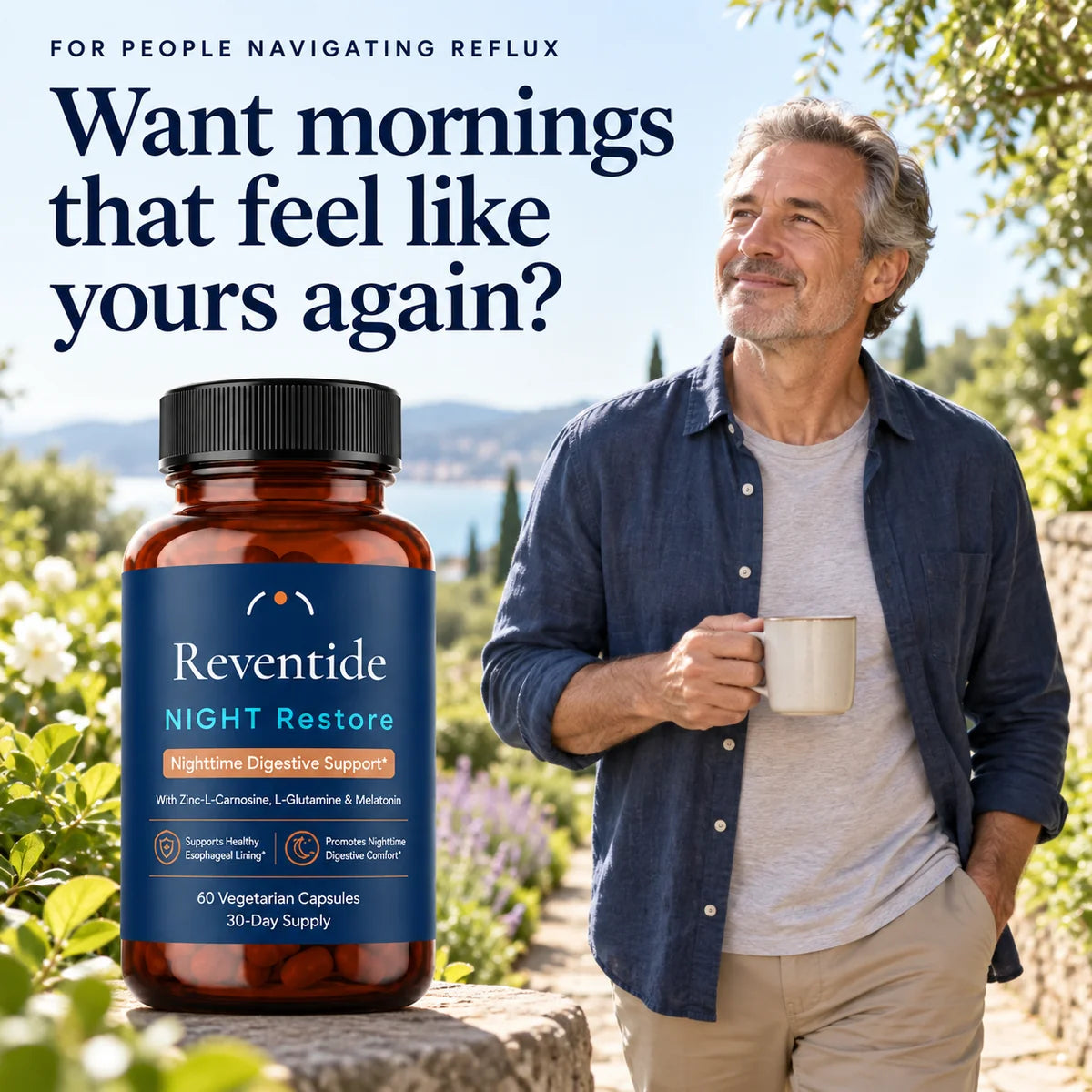
Capsules with 135 mg zinc-L-carnosine, 900 mg L-glutamine, and a low 2.7 mg dose of melatonin, plus vitamin D3. Support the lining through the long flat window, the hours the valve has to hold on its own.
One works the hours you're upright. The other works the hours you're horizontal. And they depend on each other: if the daytime raft isn't stopping acid at meals, the nighttime lining support is fighting damage that just gets reset the next day. That's why it's a protocol, not a single pill. Both formulas are made in a cGMP-certified, FDA-registered facility.
30-day money-back guarantee · free U.S. shipping · no subscription
And why it decides how much you start with
How long until you feel it?
Remember Diane's third week? Here's why it was the third week and not the first.
The daytime raft can help from the first meal. But the nighttime half, the lining support, works the way rest works: not in a single dose, but over a run of calm, uninterrupted nights. The irritation loop took seven years to wear in for her. Giving the lining a real stretch of undisturbed nights to settle is measured in weeks and months, not hours.
The reviews say the same thing. People notice around week three that the Tums roll is still full. By month two or three, they've stopped planning their evenings around their stomach entirely, the exact thing Priya described: "You plan your whole evening around your stomach," until one late dinner with friends, she realized she hadn't done that in two years.
Which is why a single 30-day kit is the wrong way to judge this. One kit stops you right around the point most people first notice anything. The honest way to test Reventide is to give it the full ~90-day window the lining actually needs. That's why the 90-day protocol is built the way it is: three kits is ninety days of supply. The money-back guarantee covers 30 days from delivery. A single kit is fine to dip a toe. But if you want to know whether you can sleep flat again, you give it the full window.
30-day money-back guarantee · free U.S. shipping · no subscription
"But I've heard all this before"
Fair. You're skeptical, and you should be. You've been burned by this category. Karen almost skipped it for exactly that reason: "I've wasted so much money on reflux stuff that did absolutely nothing that I nearly skipped this too." Three honest things.
-
1"Supplements are underdosed filler."
Often true, and it's why most do nothing. So Reventide did the opposite: no proprietary blends. Every milligram is printed on the label. Check the label against the research yourself. Nothing hidden behind a "blend."
-
2"This is just melatonin with extra steps." ★★★★★
"I already take melatonin for sleep so I assumed this was basically the same thing and rolled my eyes a little. It's not. The nighttime reflux is the part that changed for me."
Anthony P. · Cranston, RI · Verified Buyer
He's right that it's different, and the research explains why. The melatonin here is a low dose to help you fall asleep flat, but as the study above notes, it has been studied for its effect on the valve that keeps acid down. It's doing more than putting you to sleep, and it's one of four ingredients in the night formula, not the whole product.
-
3"Can I take it with my omeprazole?"
Common question, because a lot of people here are already on a PPI. Reventide is drug-free, and most people use it alongside what they're already taking, not as a swap for it. It isn't a drug and isn't designed to replace one.
If you're on a PPI or any medication, run it by your provider before adding it, not because there's a known problem, but because that's simply the right way to add anything new. Plenty of the reviews above came from people who started while still on their morning pill.
-
4"Can't I just take the night one?"
This is the fair question, and it's worth answering straight, because it's the whole reason this is two formulas instead of one.
The nighttime lining support only works if the lining actually gets a stretch of calm to settle. But every time acid rises after a daytime meal, it hits that same lining again, resetting the loop you're trying to close. Take the night formula alone and you're asking it to work on ground that's being re-irritated every single day.
Day Shield's job is to stop that daytime re-irritation at the source, so Night Restore has calm tissue to work on overnight. It's not a bundle for the sake of a bigger order. It's a protocol, because one half undoes the other's work if you leave it open.
-
5"I've genuinely tried everything."
Then you've tried everything aimed at one half of the day. That's not the same as something built for both. Neither had the people below, until this.
What changed for people who'd also given up
"Got so used to sleeping propped up on a mound of pillows that lying flat felt weird. Been on this about a month. I lay flat again."
Marcus D. · Tualatin, OR · Verified Buyer
"My husband noticed before I did, said I wasn't sitting up coughing in the middle of the night anymore. First time in a long time either of us slept straight through."
Lisa T. · Mesa, AZ · Verified Buyer
"For a while I actually dreaded going to bed because I knew what was coming. A few weeks on this and the fear part is mostly gone."
Greg W. · Boise, ID · Verified Buyer
So what happened to Diane in the third week
She slept the whole night. Flat. And when she woke up, the roll of Tums on her nightstand was untouched, the first time in years she hadn't reached for it in the dark. She wrote it almost like she couldn't believe it herself: "Somewhere in the third week I realized I'd slept the whole night. First time in years."
Seven years of propping herself up, bracing for 2 a.m., planning her nights around her stomach. Gone, not because she finally found a stronger version of what she'd already been doing, but because she stopped fighting half the day and started covering both.
That's the whole thing. You've been treating the daytime for years. The nights were the half nobody handed you.
Sleep flat again. At no risk.
30-day money-back guarantee. No subscription. If it doesn't work, every cent back, empty packaging included. You have 30 days to find out on your own 2 a.m.'s, at essentially no risk. The only thing you're committing to is finally covering the whole day instead of half of it.
The full 90-day protocol is Buy 2, Get 1 Free: 3 kits for $138, about $46 a kit, or roughly $1.53 a day. Less than the nightly Tums habit it replaces. Prefer to start small? A single 30-day kit is $69.
Choose your protocol
Choose how long you give it
30-day money-back guarantee · free U.S. shipping · no subscription
30-day money-back guarantee · free U.S. shipping · no subscription
Sources
- Leiman DA, et al. Alginate therapy is effective treatment for gastroesophageal reflux disease symptoms: a systematic review and meta-analysis. Diseases of the Esophagus, 2017;30(2):1–8. pubmed.ncbi.nlm.nih.gov/27671545
- Mahmood A, et al. Zinc carnosine, a health food supplement that stabilises small bowel integrity and stimulates gut repair processes. Gut, 2007;56(2):168–175. PMC1856764
- Kandil TS, et al. The potential therapeutic effect of melatonin in gastro-esophageal reflux disease. BMC Gastroenterology, 2010. BMC Gastroenterology
Reventide
* These statements have not been evaluated by the Food and Drug Administration. This product is not intended to diagnose, treat, cure, or prevent any disease. Cited studies refer to individual ingredients and are provided for educational context; they are not claims about this product. Individual results vary; testimonials reflect individual experiences and are not a guarantee of results. Consult your healthcare provider before use, especially if you are pregnant, nursing, taking medication (including proton pump inhibitors), or have a medical condition. Contains licorice-derived DGL; if you have high blood pressure, consult your provider. Night Restore contains melatonin, which may cause drowsiness — do not drive or operate heavy machinery after taking it. Day Shield carries 336 mg of sodium per stick; if you are on a sodium-restricted diet or have high blood pressure, talk to your doctor. This is a paid advertisement.