As promised · All four
The List: Four Things That Make Pepsin Worse
Not a list of acidic foods. A list of the four things that decide how long a digestive enzyme sits on tissue that was never built to handle it. Three of the four are not food at all.
General information, not medical advice. Never change prescription medication on your own.
The old list sorted by acid. This one sorts by what the acid brings up with it.
Here they are.
No email, no sign-up, nothing to download. All four are below, in full, before anything else on this page. Read them, screenshot them, and close the tab if that is all you came for. It costs nothing and it is yours either way.
One thing said plainly, up front: this page is published by Reventide, and Reventide sells a reflux supplement. The four entries are textbook physiology. They stand on their own whether you ever buy anything or not, and we would rather you heard that from us than worked it out halfway down.
-
1The gap between the last full meal and lying down
Not a food at all. Nothing travels up out of an empty stomach, so the question was never only what you ate. It is what is still sitting there when you go horizontal. Of the four, this is the one most people can move the furthest, and it is free.
-
2Being flat rather than raised
All day, without noticing, you do two things that clear your throat: you swallow, and saliva runs. Asleep and flat, you do neither. Whatever arrives up there in those hours has nothing washing it back down, and it stays until you wake up. That is why for most people the worst stretch is the first hour of the morning rather than the middle of the night.
-
3Nicotine, in every form
Gum, pouches and vapes deliver the same compound as cigarettes. It cuts saliva flow, and saliva is the only thing rinsing the back of the throat between meals. Less saliva means more contact time, and contact time is the whole story with this enzyme.
-
4The fat and the size of the meal
This is the single food entry, and even this one is not about acid. Fat slows how fast the stomach empties, and volume gives it more to empty. A cream sauce carries no acid whatsoever and still leaves the stomach loaded for hours. The same food, split across two smaller meals, is a different situation entirely.
This is general information about factors commonly described in gastrointestinal physiology. It is not medical advice, it is not a diagnosis, and it is not a treatment plan. If you are on a prescription for reflux, this is something to bring to your doctor, not something to act on instead of one.
Why the two lists disagree
The first list was sorted by the wrong thing
The list most people get handed is a list of acidic foods. Tomatoes, citrus, coffee, vinegar, anything sharp. It is an intuitive list. It is also sorted by a property of the food rather than by what happens in the body, and those two things come apart almost immediately.
Notice that not one of the four entries above is on it. Notice also that the four have nothing in common as foods, because they are not sorted as foods. They are sorted by one question: how long does the enzyme get to sit up there.
Here is the part that makes that question the right one.
The stomach makes an enzyme that breaks down protein, behind a thick protective lining. The throat has nothing like that lining, and the enzyme that gets up there is called pepsin.
Acid burns. Pepsin digests. That is a real difference, and it is the reason the two sensations are so different. Acid announces itself as heat behind the breastbone. Pepsin does not burn, so there is often nothing to feel at all, which is exactly why so many people spend a year clearing their throat every morning and never once think the word reflux.
It was never only how much acid. It was what the acid carried up with it, and how long that stayed.
And pepsin does not leave when the acid does. Acid gets diluted, swallowed and buffered over the following hours. The enzyme is a protein sitting on tissue, and it is still there long after the burning would have been gone. That is the whole reason a list sorted by acidity misses it.
Sort by acidity and you get one list. Sort by contact time and you get these four.
The honest limit
What these four cannot do for you
Here is the part that would be easy to leave out, and we are not going to, because you have almost certainly already run into it.
You can work all four perfectly and still clear your throat at seven in the morning.
Every one of them is a thing to subtract. Eat earlier, sleep raised, drop the nicotine, eat smaller. Subtraction works, and for some people it is most of the answer. But subtracting does not put anything in place. There is still a stretch of hours every night when the stomach is doing whatever it does and nobody is supervising it, and none of the four entries is standing between the two.
That is a different job, and it is where almost everybody gets stuck.
The two things already in the house
Why neither one is built for this
Most people reading this have two things within arm’s reach right now, and both were bought for exactly this problem.
Antacids. They neutralize what has already come up. On a bad night that is the difference between sleeping and not. But look at the timing built into the word: they arrive after. Something came up, and then you reached for the roll. Neutralizing acid does nothing to a protein, which is why the roll on the nightstand is gone by Thursday every week and the throat clearing is unchanged.
The once-a-day pill. It lowers how much acid the stomach makes. That is real, it is well understood, and for a lot of people it made the burning livable. It is also a different job entirely. Pepsin is not acid, it is an enzyme, and less acid in the stomach does not mean less enzyme travelling up with it. Lower the acid and what arrives is simply less acidic than it would have been. The enzyme is still sitting up there.
What lowering acid does
- Reduces how much acid the stomach produces
- Takes the burn out of what comes up
- Well studied, well understood, prescribed for good reasons
- Works on the acid, in the stomach
What it was never designed to do
- Remove the enzyme that travels up alongside the acid
- Put anything physical between the stomach contents and the throat
- Cover the hours you are flat and not swallowing
- Shorten how long anything sits on the tissue up there
That is not a flaw in the pill. That is a scope. The pill does exactly what it says on the box, and the box never said anything about the enzyme.
And then there is the part almost nobody puts plainly, which is what happens when someone decides to stop.
Read that carefully, because it is easy to over-read. Those were healthy volunteers. They had nothing wrong with them going in. The symptoms showed up after they came off, not while they were on it.
That is a fact about a drug, not an instruction, and it is certainly not a reason to stop taking anything. It is here for one reason: if you have ever tried to come off a prescription and everything came back worse within days, that experience is documented, and it was not weakness or imagination on your part. Talk to your doctor before changing any prescription. Nothing on this page is a taper plan and nothing here replaces what your doctor has you on.
The four entries subtract. The pill lowers. Neither one puts anything in the way.
What can actually be in the way
A lid on the pool, hours before you lie down
If contact time is the problem, then the useful question is not how to make the stomach less acidic. It is what can physically sit between the stomach contents and the trip upward, and be there before anything moves.
There is an old, unglamorous answer to that, and most people who have spent a year on this have already bumped into it.
A raft on top of what you just ate
Sodium alginate is pulled from seaweed. Stirred into water and drunk after your largest meal, it forms a light gel raft that floats on top of the stomach contents. Not a coating on your throat. A physical layer sitting on top of the pool, put in place hours before you go flat. It is not absorbed into your body. Whatever travels up has to come through it — the acid, and what the acid carries.
Sodium Alginate · 1,000 mg · day drink
The calcium carbonate and sodium bicarbonate in the same stick are not there to be an antacid. They are the chemistry that makes the raft form and float. The buffering is a side effect, not the point.
The slow one, and the reason ninety days matters
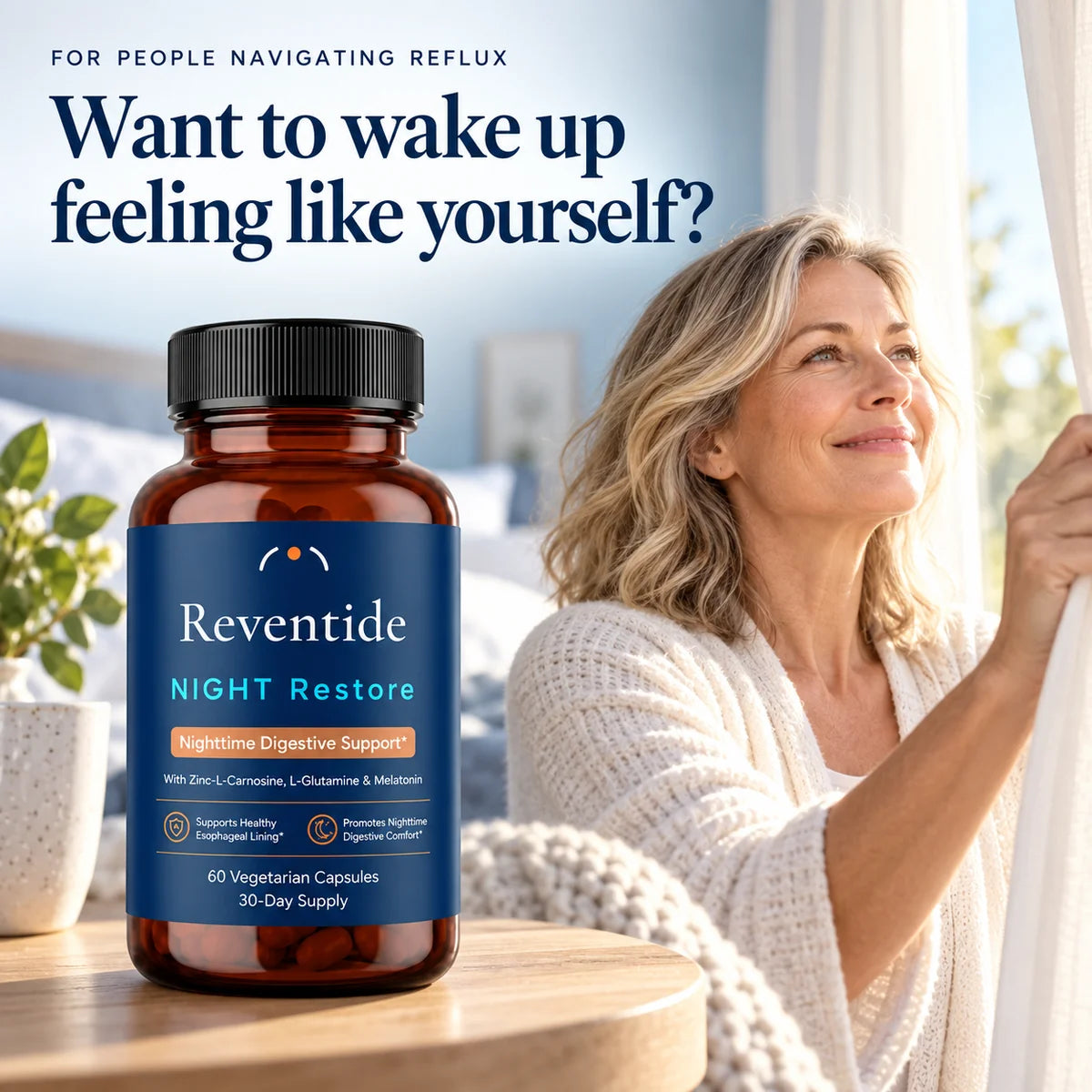
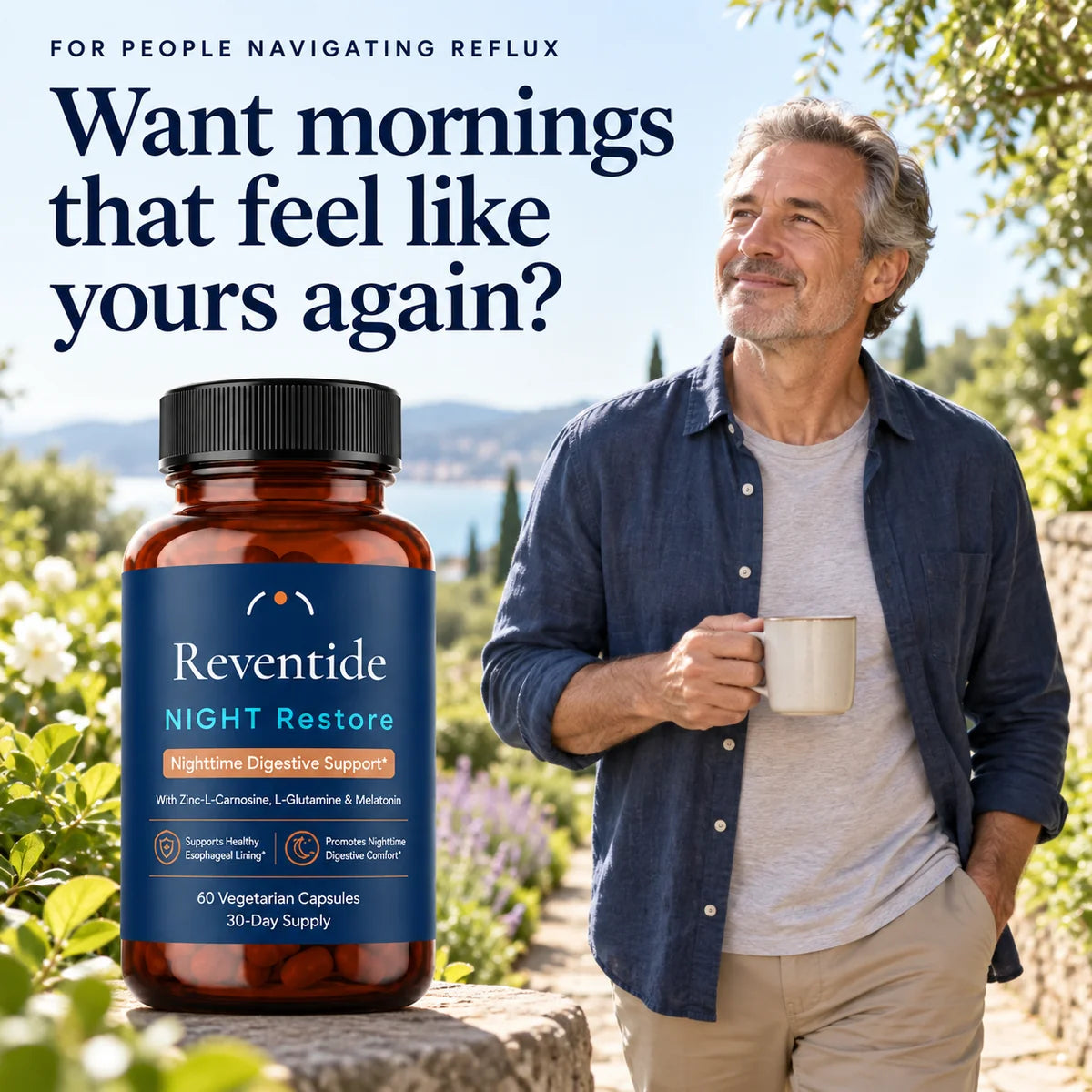
Years of this leave tissue irritated, and that part does not change in a week. In a randomized, placebo-controlled trial, a zinc-carnosine complex helped support intestinal lining integrity in healthy adults exposed to a common gut irritant. Night Restore provides 135 mg of zinc carnosine per serving, alongside 900 mg of L-glutamine and 1,800 IU of vitamin D3. Research on the ingredient, not on our finished product.
Zinc-L-Carnosine · 135 mg · night capsulesMelatonin, at a dose nobody takes to fall asleep
This is the part people roll their eyes at and then read twice. Melatonin is not only a sleep hormone. Researchers report the gut contains at least 400× more melatonin than the pineal gland, the gland in the brain that releases it at night (a review in Digestive Diseases and Sciences, 2002). It has been studied for its effect on lower esophageal sphincter tone, in one small clinical study, at 3 mg taken at bedtime. Night Restore provides 2.7 mg. Research on the ingredient, not on our finished product.
Melatonin · 2.7 mg · night capsulesIf you already take melatonin for sleep, the difference is dose and timing rather than the compound. Ten milligrams taken to knock yourself out is a different intervention from a small dose about thirty minutes before bed.
That is the whole routine. One stick in water after your largest meal. Two capsules about thirty minutes before bed. No melatonin in the day drink, so nothing makes you foggy at your desk.
30-day money-back guarantee · no subscription
The question we get most
“Isn’t this the one people order from the UK?”
If you have spent any time in the forums where people compare notes on a cough nobody can explain, you have already met alginate. Somebody in every thread recommends it, usually with a note that the version sold in the United States is not the same formula and that the good one has to be shipped in.
So we are not introducing you to a mechanism. Most people who land on this page worked out years ago that a physical barrier was what they wanted. They went looking, hit the shipping, and gave up.
Day Shield is a powder stick, made in the US, with sodium alginate at 1,000 mg and every other milligram printed on the box. That is the entire pitch on that point. If you already knew you wanted alginate, this is one that ships.

Nothing hidden
Every milligram is printed
You have been burned by labels before, so here is ours, in full, before you have decided anything.
Made in a cGMP-certified, FDA-registered facility. No proprietary blend. No ingredient named without a number next to it. The DGL in the day stick is listed because it is in there, and we attach no study claim to it.
And two numbers we would rather you heard from us. The 1,000 mg of alginate is a fraction of what those trials used across a day, and we are not going to pretend otherwise. Each stick also carries 336 mg of sodium. If you are on a sodium-restricted diet or have high blood pressure, that is a conversation for your doctor before you order, not after.
In their words
From people who ordered while expecting nothing
These are our own customers, quoted exactly as they wrote them. We will be straight with you about one thing: none of them came to us because of a cough. They came for the nights. Those are the reviews we have, so those are the reviews we are showing you. Individual results vary.
“I almost didn’t order, because I’ve been burned by ‘clinically formulated’ supplements before. … Didn’t end up needing it.”
Alicia D. · Verified Buyer
“Six years, more doctors than I can count. Prescription meds did next to nothing for the nights. The 2am episodes have gotten rare enough that I actually sleep now. That alone is worth it to me.”
Robert H. · Erie, PA · Verified Buyer
“I already take melatonin for sleep so I assumed this was basically the same thing and rolled my eyes a little. It’s not. The nighttime reflux is the part that changed for me.”
Anthony P. · Cranston, RI · Verified Buyer
“Got so used to sleeping propped up on a mound of pillows that lying flat felt weird. Been on this about a month. I lay flat again.”
Marcus D. · Tualatin, OR · Verified Buyer
What you are risking
The honest part: you have been wrong about this before
The thing actually stopping you is not the money, and we both know it.
It is that you have spent on this category before, more than once, and each time you had to quietly admit afterwards that you fell for it again. That is a worse feeling than losing the money. It is the reason the half-used jar is still in the cupboard instead of the bin.
So the guarantee was built for that, not for the money.
Take the full thirty days and use it properly. If nothing has changed, send the kits back for a full refund, empty packaging included. We do not ask for unopened boxes, because a product you never opened tells neither of us anything.
It is a one-time purchase, not a subscription. Nothing renews, nothing to cancel, no card on file waiting to charge you next month.
The money-back guarantee covers 30 days from delivery, regardless of the supply size you choose.
Full ingredients, doses and options on the product page
This is a dietary supplement, not a drug.
The four entries at the top of this page are yours whether or not you ever order anything from us. Screenshot them, print them, take them to your doctor.
Everything after them exists because all four are things to subtract, and subtracting puts nothing in the way for the hours you cannot supervise.
Sincerely,
Reventide
P.S. If you only take one entry from that list, take the first one. Three hours upright after your last full meal costs nothing, and of the four it is the one that changes the flat stretch the most.